

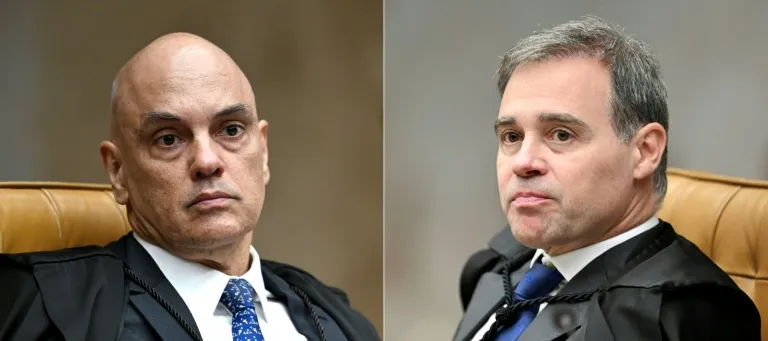
Brazil’s Supreme Court is examining allegations of impropriety involving Justice Alexandre de Moraes, a prominent figure in the nation’s judiciary, and a jailed banker whose fraud case has sent shockwaves through the country’s political and legal circles. The investigation centers on a police report that surfaced recently, detailing alleged communications between the banker and Moraes.
Background of the Crisis
The controversy stems from the arrest of Daniel Vorcaro, a banker whose private institution, Banco Master, collapsed. Vorcaro faces charges of fraud, and his detention has unraveled a complex network of connections involving judges, legislators, and political figures. The revelations have intensified in the lead-up to upcoming elections, casting a shadow over the political landscape.
Alexandre de Moraes, 57, is a justice on the Supreme Court and has presided over significant legal proceedings, including the 2025 trial that resulted in the conviction of former President Jair Bolsonaro. He is now at the center of a crisis linked to the Vorcaro fraud case, which has reached the highest levels of power.
The Unsealed Police Report
The current scrutiny intensified two weeks ago when Justice Andre Mendonca, appointed during the Jair Bolsonaro administration, unsealed a police report related to the Vorcaro investigation. This report contained messages purportedly sent by Vorcaro to a phone number identified as belonging to Moraes. In these messages, the banker allegedly sought Moraes’s assistance concerning the fraud investigation against him.
The Supreme Court’s president, Edson Fachin, convened a special plenary session to address the validity of this police report. The session was broadcast live on television and YouTube, underscoring the national interest and the gravity of the situation. The court was expected to deliberate on whether to initiate a formal investigation into Moraes himself.
Moraes’s Response and Court Security
In response to the unfolding events, Justice Moraes formally requested Fachin to nullify the proceedings. Moraes asserted that the police report had been “deliberately steered” by Justice Mendonca with the intention of implicating him for “political and electoral purposes.”
In anticipation of the high-stakes session, security measures were significantly enhanced at the Supreme Court’s headquarters in Brasilia. The presence of armed guards and bomb-sniffing dogs highlighted the tense atmosphere surrounding the proceedings.
The political ramifications of this crisis are substantial. Sostenes Cavalcante, the leader of former President Bolsonaro’s Liberal Party in the Chamber of Deputies, remarked on the session’s importance, stating, “This plenary session is more important than the World Cup final.”
Political Context and Election Impact
This judicial controversy has become a dominant theme in the campaign leading up to the October 4 elections. The race is anticipated to be a closely contested one, primarily between the incumbent leftist President Luiz Inacio Lula da Silva and Flavio Bolsonaro, the eldest son of former President Jair Bolsonaro.
President Lula has publicly called for transparency and accountability for any wrongdoing. In contrast, Flavio Bolsonaro has been openly critical of Justice Moraes.
Flavio Bolsonaro’s Own Investigations
Adding another layer of complexity, Flavio Bolsonaro himself is currently under investigation for alleged corruption and money laundering. These suspicions are linked to the financing of a film produced about his father. Notably, funds for this film reportedly originated from Daniel Vorcaro, the banker at the heart of the current fraud scandal.
The interconnectedness of these cases—the banker’s fraud, the alleged communications with Justice Moraes, and Flavio Bolsonaro’s financial dealings—has created a deeply intricate web that is being untangled by Brazil’s highest court.
Conclusion
The Supreme Court’s examination of Justice Alexandre de Moraes’s alleged ties to Daniel Vorcaro represents a critical juncture for Brazil’s judiciary and its political stability. The outcome of this investigation and the court’s decisions will have significant implications for public trust in the legal system and the ongoing electoral contest. The focus remains on ensuring transparency and upholding the rule of law amidst these complex and politically charged circumstances.
