

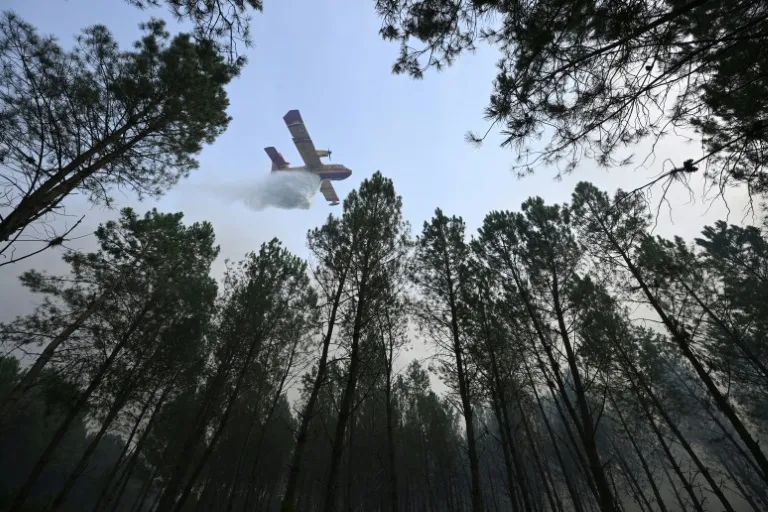
A severe heatwave across Europe has intensified the risk of wildfires, leading to significant blazes in multiple countries and prompting evacuations. The extreme summer temperatures have created tinderbox conditions, challenging firefighting efforts across the continent. This report details the latest developments in affected regions.
France: Reignited Blaze Forces Renewed Evacuations
In southwestern France, a forest fire in the Landes region, which had been burning since Thursday, reignited early Saturday. This resurgence necessitated the evacuation of an additional 100 residents and holidaymakers from the vicinity of Luglon. Regional government prefect Gilles Clavreul stated that the fire has consumed approximately 16 square kilometers of forest. In total, around 650 people have been displaced from their homes due to the blaze. Over 550 firefighters are engaged in combating the flames, which are near the site of another significant fire in July that scorched 37 square kilometers. Clavreul has requested government assistance, including the deployment of a Chinook water-bombing helicopter, to aid in managing France’s wildfire crisis.
Belgium and Germany: Cross-Border Firefighting Efforts
Eastern Belgium’s Fagnes natural park, situated near the German border, is grappling with a wildfire that has spread rapidly since igniting on Friday. Authorities report that the blaze has destroyed about 16 square kilometers of forest. In response, firefighter reinforcements have been mobilized from across Belgium and from Germany to assist in containment efforts. Germany’s Eifel region, directly across the border from Belgium, is also experiencing a major fire. On Saturday, approximately 1,400 firefighters were working to control this blaze in Hurtgenwald. The fire has led to the evacuation of 1,800 residents from the town, which has a population of 9,000.
Croatia: Island and Peninsula Fires Under Control
Croatia has seen significant firefighting activity, particularly on the island of Dugi otok. More than 100 firefighters, supported by two water-bombing planes, worked through the night to contain a major forest fire that erupted on Friday, posing a threat to numerous homes. Separately, a large fire that had engulfed vineyards and olive groves on the Peljesac peninsula to the south was brought under control on Friday evening. This incident involved a fierce response from 240 firefighters and three aircraft.
Serbia: Widespread Fires Threaten National Park
Serbian authorities reported late Friday that they were contending with 25 serious forest fires across the country. Among these, one particularly devastating blaze has consumed 25 square kilometers of land within the Deliblatska national park, located near Belgrade. The scale of these fires underscores the widespread vulnerability of natural landscapes to the current weather conditions.
Spain: Long-Burning Fire Nears Containment
In Spain’s northeastern Aragon region, a fire has been burning for six consecutive days, impacting over 15,000 hectares. Firefighting crews have reported success in halting the fire’s advance towards populated areas and two historic monasteries, one dating back to the 10th century. Approximately 1,000 individuals from 18 villages and settlements remain evacuated. Favorable weather forecasts, predicting light rain and lower temperatures, offer hope for further containment.
Greece: High Alert Amidst Windy Conditions
Greece remains on high alert due to persistent strong winds, which significantly elevate the risk of fires in several regions. The fire service reported that over 50 agricultural and forest fires broke out within the past 24 hours. Fortunately, the majority of these were quickly brought under control, preventing widespread damage. The ongoing high-risk conditions, however, necessitate continued vigilance from emergency services.
Broader Context: Heatwave’s Impact
The current wildfire situation across Europe is a stark illustration of the escalating impacts of climate change. Record-breaking temperatures, as experienced during this summer’s heatwave, create ideal conditions for fires to ignite and spread rapidly. The combination of dry vegetation, high temperatures, and, in some areas, strong winds, presents a formidable challenge for firefighters. The extensive resources required to combat these blazes, including personnel, aircraft, and equipment, highlight the significant economic and environmental costs associated with such events. Furthermore, the displacement of communities and the destruction of natural habitats underscore the human and ecological toll of these recurring crises. International cooperation, as seen with the deployment of resources between Belgium and Germany, is becoming increasingly crucial in managing cross-border environmental emergencies.
Conclusion
As Europe continues to experience an unusually hot summer, the threat of wildfires remains acute. Firefighting teams across France, Belgium, Germany, Croatia, Serbia, Spain, and Greece are working tirelessly to control blazes that have already caused significant damage and displacement. The ongoing efforts highlight the critical need for robust fire prevention strategies, rapid response capabilities, and continued international collaboration in the face of a changing climate.
