

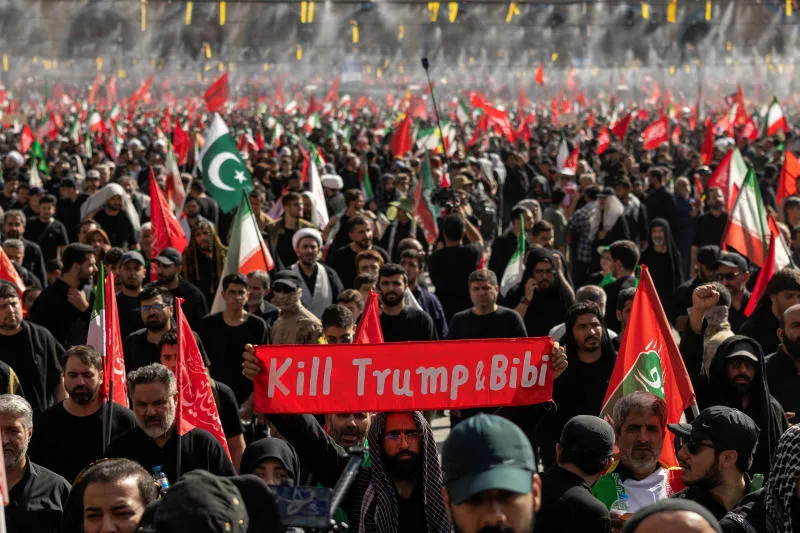
The funeral for a prominent Iranian leader, killed in a recent conflict, saw three of his sons present, but notably absent was his presumed successor, Mojtaba Khamenei. State television broadcast images of Mostafa, Meysam, and Masoud Khamenei participating in funeral prayers at the Imam Khomeini Grand Mosalla in Tehran. Their father, along with other family members, perished in an airstrike on February 28, marking the commencement of hostilities between the United States and Israel against Iran. The conflict, which lasted several weeks before a fragile ceasefire was established, resulted in widespread devastation across the region and left Iran’s established government, supported by the Islamic Revolutionary Guards Corps, in power.
Mass Funeral Processions Honor Slain Leader
The Islamic Republic has organized a week-long series of public funeral processions to commemorate the deceased leader. These events are intended to demonstrate public loyalty to the state and its revolutionary principles. As part of the itinerary, the leader’s remains are being transported to significant Shi’ite religious sites in neighboring Iraq. Following a period of lying in state for senior officials and foreign dignitaries, the coffin, alongside those of his daughter, son-in-law, daughter-in-law, and 14-month-old granddaughter, was displayed outdoors under glass on Saturday.
Succession Uncertainty Surrounds Mojtaba Khamenei’s Absence
A significant point of discussion and disappointment among mourners has been the absence of Mojtaba Khamenei, widely believed to be the intended successor. He has not been publicly seen or photographed since the February 28 attack that claimed his father and other relatives. Sources close to his inner circle have indicated to news agencies that Mojtaba sustained severe injuries, including facial disfigurement and significant leg trauma, during the bombing of Iranian targets that initiated the war. One young woman attending the funeral expressed her dashed hopes, stating, “Until the last moment, before the prayer began, I kept telling those around me that I hoped (Mojtaba Khamenei) himself would come. That was our only wish.”
Ceasefire and Political Landscape
A ceasefire has been implemented, halting the four-month-old war. This agreement with Washington, according to Iranian authorities, is expected to yield substantial economic benefits, which they characterize as a victory over a superpower. U.S. President Donald Trump confirmed that peace talks were temporarily paused for a week to accommodate the funeral proceedings. On Sunday, Iranian President Masoud Pezeshkian and Parliament Speaker Mohammad Baqer Qalibaf also participated in the funeral prayers behind the coffins.
Public Mourning and Logistics
Masoud Khamenei was visibly emotional during the prayers, seen wiping away tears while an imam led the funeral rites. The Mosalla complex has been thronged with grieving crowds, many weeping and engaging in traditional chest-beating rituals. The scale of public participation is underscored by the Iranian metro railway system, which recorded 7 million trips between Saturday evening and Sunday morning as citizens flocked to the central mourning site. Authorities are anticipating massive turnouts for subsequent processions, including a major event in central Tehran on Monday. Following this, the remains will be taken to Qom, a major Shi’ite clerical center, for ceremonies on Tuesday. The itinerary includes travel to Iraq for services at the holy shrines of Najaf and Kerbala on Wednesday, before returning to Iran for a final procession in Mashhad and burial near the tomb of a revered Shi’ite imam. Extensive logistical support, including transportation, food, and accommodation, is being mobilized to facilitate public participation in the coming days.
Future Processions and International Travel
The planned processions are designed to involve millions of people across several key locations. After the main event in Tehran on Monday, the leader’s remains are scheduled to be transported to the seminary city of Qom for further ceremonies on Tuesday. This will be followed by a significant international leg of the funeral, with the body being flown to Iraq. There, ceremonies will be held at the prominent Shi’ite holy shrine cities of Najaf and Kerbala on Wednesday. The remains are expected to return to Iran on Thursday for a final procession in Mashhad, where the burial will take place near the tomb of a revered medieval Shi’ite imam. Iranian authorities are actively planning to mobilize millions of participants for these extensive public events, providing necessary resources such as transport, food, and lodging to accommodate the large numbers expected.
