

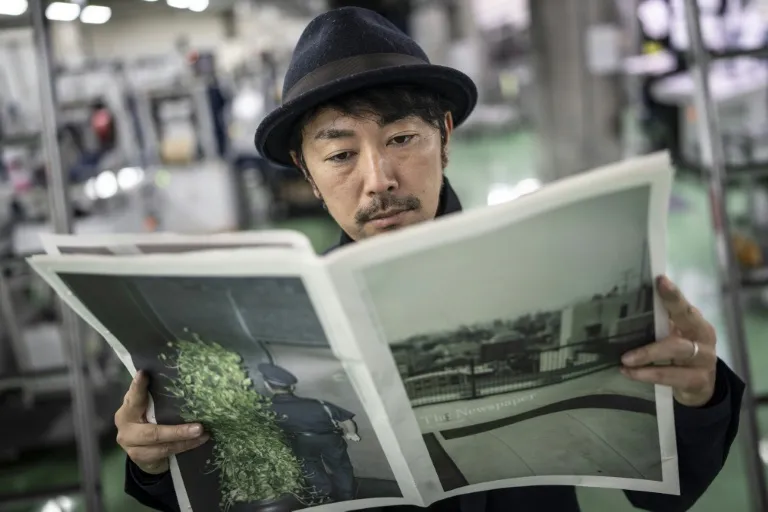
Despite a significant downturn in the traditional publishing sector, self-published and handmade “zine” magazines are experiencing a surge in popularity across Japan. This trend highlights a persistent cultural appreciation for physical media in an increasingly digital world.
A Sensory Experience Beyond Screens
Kazuma Obara, a creator whose hands were stained with ink, described the unique appeal of paper publications. “I think (paper) is a medium that engages all five senses,” he explained, contrasting it with the often solitary experience of social media.
Obara and his collaborator, Akihico Mori, are among the artists utilizing a printing press offered by the Kyoto Shimbun newspaper. The newspaper is exploring new avenues for its machinery as subscription numbers decline. As their work was printed on newsprint, technicians meticulously checked the quality of each page.
“I think print media is incredibly open. You can hand it to someone, you can read it together,” the 40-year-old photographer Obara stated. He characterized mobile phones as “very insular.” Mori, a writer aged 44, added that individuals can “feel the creator’s passion when they hold the work in their hands.” He emphasized, “I think that’s what makes it so appealing, and AI simply can’t replicate it.”
The Resurgence of Independent Publishing
The pair’s creations were recently featured at the international photography festival, Kyotographie. Yoshihiko Okazaki of Kyoto Shimbun Printing noted that their services have attracted a diverse range of artists, from teenagers to individuals in their seventies. “Surprisingly, it resonates with younger people… I even hear comments like, ‘it’s interesting precisely because it’s old,'” Okazaki observed.
Japan’s print media landscape has seen a dramatic contraction. Book and magazine sales have plummeted to approximately 40% of their 1996 peak, which was valued at ¥2.6 trillion (approximately US$16.3 billion). Newspaper circulation, which reached a high of 53.76 million in 1997, has subsequently fallen by more than half.
The rise of artificial intelligence and social media fuels concerns among authors and publishers globally about the future of their work. However, mirroring trends in other nations, do-it-yourself publications, including zines—which have roots dating back to the 1930s among science fiction enthusiasts—are gaining traction in Japan, particularly among younger demographics. reports one private research firm suggest the self-publishing market is projected to reach ¥150 billion for the year ending March 2026, nearly doubling its value from four years prior.
The Enduring Charm of the Tangible
In Tokyo, a recent zine fair drew hundreds of visitors eager to explore a wide array of handmade magazines. These publications featured diverse formats and content, including abstract designs, photography, and personal narratives.
Harumi Kikuchi, a 22-year-old visitor, commented on the nature of digital platforms. “AI and social media are driven by algorithms that feed us nothing but what we want to see or what suits us best,” she said. “But the fact that many zine makers are here suggests there are many different worldviews.”
Zine creator Watashi Kishino, who illustrates her daily life in black-and-white, acknowledged the capabilities of modern technology. “People can make a lot of things with AI and digital technology,” she stated. “But I believe there’s a charm in having something tangible to hold in your hands like this.”
Bookstores Embrace the Trend
Major bookstores are also recognizing the appeal of zines as younger generations increasingly move away from traditional physical books. Sanseido, a 145-year-old bookstore located in Tokyo’s Jimbocho book district, began stocking zines approximately a year ago.
Masato Sugiura, deputy head of the sales promotion unit, explained the bookstore’s strategy. “We felt that zines could appeal to a different audience than traditional readers,” he noted. “Everyone is looking for something that really speaks to them. Readers are perhaps drawn more to zines, which are niche and cover a broader range of topics.”
Kishino remains optimistic about the enduring presence of physical books and magazines. “There’s warmth that only paper can offer,” she concluded. “There’s definitely people who are looking for that.”
