

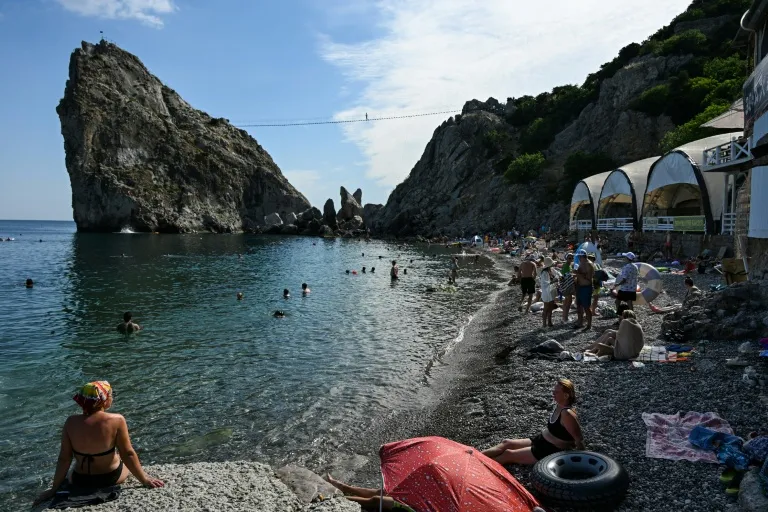
Crimea is experiencing a summer marked by heightened tension, characterized by frequent drone incursions and disruptive power outages. Residents are navigating daily life amidst escalating Ukrainian strikes targeting the peninsula’s energy infrastructure. While official Russian sources sometimes attribute sounds of explosions to air defense drills, the reality on the ground involves tangible impacts on civilian life, including casualties and widespread disruptions.
Escalating Ukrainian Attacks on Crimea
Ukraine has intensified its campaign against the Black Sea peninsula, a region annexed by Russia in 2014 and a popular tourist destination. Recent months have seen a significant increase in strikes aimed at fuel depots and electrical facilities. These attacks, which began ramping up in June, have become more frequent, leading to casualties. Crimea’s governor, Sergei Aksyonov, reported that two civilians were killed in overnight attacks between Tuesday and Wednesday.
The impact of these strikes is felt across Crimea’s population of approximately 2.4 million people. Blackouts and fuel shortages have become a regular feature of daily life. The local electricity distributor, Crimenergo, regularly announces planned power outages on its website. In response to the ongoing situation, authorities have implemented a local state of emergency, which has included halting petrol sales to the general public.
Civilian Resilience and Economic Strain
Despite the disruptions, many residents are striving to maintain a sense of normalcy. Georgy, who works in the tourism sector, expressed a sentiment of weary adaptation. “We’re already used to it, really… nothing scares us anymore,” he told Agence France-Presse (AFP). He noted that sounds are often dismissed as drills, allowing people to continue with their routines, such as enjoying coffee by the seafront or teenagers practicing at a skatepark near designated bomb shelters.
However, the economic realities are stark. Businesses and hotels in seaside resorts that can afford it have invested in generators to ensure continuous operation. Oksana, a grocery store owner in Yalta, explained the necessity of her generator. “I have no choice… otherwise the sorbets will melt. This year is just a catastrophe,” she stated, her words underscored by the hum of her generator.
Strategic Importance and Infrastructure Challenges
Crimea holds significant symbolic and political importance for Russia. President Vladimir Putin has promoted the narrative of improved living standards for Crimeans under Moscow’s rule, a claim largely unrecognized by the international community, with most countries not acknowledging the peninsula as Russian territory. The presence of Russian air defense batteries is now a common sight across the peninsula.
The peninsula’s infrastructure faces constant threats. Partially blackened facades of electric substations bear witness to Ukrainian drone strikes. Gas stations are often closed or serve only essential transport. When fuel does become available to regular drivers, prices are notably high, with a liter of 95-octane unleaded petrol costing around 250 rubles (approximately $3), which is three to four times its pre-war price. Local officials reportedly avoid displaying prices to prevent public discontent.
Supply Chain Vulnerabilities
Transporting essential supplies to Crimea has become increasingly perilous. Ukraine actively targets tankers and haulers on the northern route connecting Crimea to Rostov-on-Don via Russian-controlled southern Ukraine, a route infamously dubbed the “road of death.”
The eastern route, across the Kerch Bridge, a 19-kilometer (12-mile) road-and-rail link and a symbol of Russia’s annexation, is also frequently targeted. A 2022 attack involved explosives packed into a truck driven across the bridge. To mitigate risks, fuel tankers are now prohibited from using this vital link. There is currently no publicly available information regarding contingency plans should the Kerch Bridge be rendered inoperable again.
Kyiv’s Objectives and International Stance
Ukraine’s strategic aim in targeting Crimea is to “create the conditions under which Russia will be forced to choose peace,” according to Ukrainian President Volodymyr Zelensky. Kyiv also views these actions as a justified response to Russia’s attacks on Ukrainian cities.
Maria Snegovaya, a researcher at the Center for Strategic and International Studies (CSIS), described Crimea as “the crown jewel of Russia’s territorial conquests since 2014 with an entire mythology built around it.” She elaborated that while the occupation of Donbas is often framed as protecting Russian speakers, Crimea is presented as historically sacred Russian land. Ukraine, however, rejects this narrative, and the international community overwhelmingly does not recognize Russian sovereignty over the peninsula.
Resident Perspectives and Future Uncertainty
While local officials did not provide comments for this report, some residents have expressed a desire to leave. Reports indicate that some residents have departed the peninsula since the conflict began, though specific figures are unavailable. For students like Ekaterina and Anastasia, who are studying in Moscow, the contrast with their home is stark. “Where people have never heard an air-raid siren,” Ekaterina remarked.
Ekaterina, an 18-year-old fashion student, expressed a desire to live abroad, perhaps in Asia, though acknowledged the difficulties in obtaining residency. “Maybe somewhere like the Netherlands, or other European countries, there are more options there,” she mused, highlighting a sentiment of seeking stability away from the ongoing conflict.
Conclusion
Crimea’s summer is defined by a precarious balance between the desire for normalcy and the persistent threat of conflict. The dual pressures of Ukrainian drone attacks and the resulting infrastructure damage, particularly to the power grid, create a challenging environment for its residents and economy. While resilience is evident, the long-term implications for the peninsula remain uncertain amidst the ongoing geopolitical tensions and the strategic importance both sides place on Crimea.
