

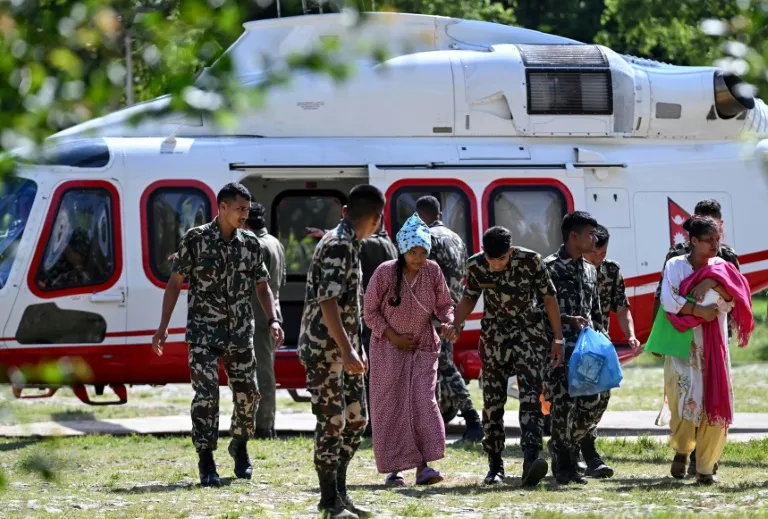
Helicopter crews are actively rescuing survivors from valleys devastated by a massive flood, triggered by what is believed to be a glacier’s collapse. The catastrophic event unleashed a torrent of water and debris, leaving a trail of destruction. As of Friday, authorities reported over 1,400 people missing, a significant number of whom are foreign tourists, with the confirmed death toll exceeding 550. Survivors have shared harrowing accounts of their experiences, detailing the suddenness and ferocity of the disaster.
Pilgrims Describe Being ‘Suddenly Engulfed’
Sivaranjani Muthunathan, a 46-year-old traveler from India’s Tamil Nadu state, was on a bus with 55 other pilgrims heading towards the Chinese border when their journey was abruptly halted by what they initially perceived as a traffic jam. Suddenly, a dense fog or smoke descended, followed by an overwhelming surge.
“Then there was fog, smoke, something that seemed to suddenly engulf us,” Muthunathan recounted, showing a video captured on her phone depicting a powerful torrent rapidly approaching. The bus and its occupants found themselves trapped as vehicles around them were swept away or buried under the rapidly accumulating mud and debris.
“One by one, we also climbed out through the driver’s side,” she explained, describing her desperate scramble up a nearby hill to safety. Another pilgrim from the same group, 53-year-old Vijayabhuvaneshwari, who provided only her first name, emphasized the lack of options.
“We had no choice,” she stated. “Every vehicle in front of us, behind us, was gone.” The group’s perilous ascent was accompanied by terrifying sounds.
“As we were climbing up, we could hear what felt like explosions,” Vijayabhuvaneshwari said. “They were rocks and boulders crashing.” The challenging terrain and the struggle of older members to ascend the slippery bank prompted Poonguzhali Ponmambadan, 61, to take decisive action. She removed her sari and fashioned it into a makeshift rope.
“He used it as a harness to lift several old people,” Ponmambadan said of her husband, who utilized the sari to help pull elderly members of their group to safety.
Dam Workers Witness Devastation
Workers at dam projects situated along the Trishuli valley shared equally grim testimonies, describing a disaster that unfolded with shocking rapidity. Dev Shrestha, who was airlifted from his worksite, reported that the area had been home to at least 400 workers.
“More people died than were rescued,” Shrestha told reporters after his rescue, highlighting the overwhelming scale of the tragedy. Buddha Tamang, another worker, recounted his narrow escape. He was inside a tunnel at the dam when the floodwaters struck, a location that ultimately saved his life.
“I survived as I was in the tunnel,” Tamang said, explaining that he was marooned for over 24 hours before being airlifted on Thursday. “The senior officers working on the other side, they were all swept away.” Arjun Kumar Tamang, an engineer at a local hydropower site, spoke of the extensive destruction.
“I don’t know how many people died but the force of the water swept everything away,” he stated, conveying the immense power of the floodwaters that obliterated the infrastructure and likely claimed many lives.
Engineer Describes ‘Only the River Remained’
Ananay Sharma, a 29-year-old engineer from India working on a project in the affected region, was at the powerhouse when the incident occurred. He heard a loud noise, noticed water seepage, and was instructed to evacuate.
“When I came out, everything was gone, only the river remained,” Sharma described, painting a stark picture of the aftermath. “One residential camp completely washed away, another remains where we took shelter.” His account underscores the complete obliteration of parts of the area.
’20 Seconds to React’
Gorakh Khatka, an engineer located in the Shanti Bazar area, close to the disaster’s epicenter, recounted a desperate flight for survival. He estimated that the time available to react before the mud and water reached approximately 20 feet (six meters) high was a mere 20 seconds.
“We ran for our lives and spent more than 48 hours on a hill before help finally arrived,” Khatka said, emphasizing the extreme conditions and the prolonged period of uncertainty and vulnerability faced by those who survived the initial onslaught.
The ongoing rescue efforts continue to search for the missing, while survivors grapple with the trauma and loss inflicted by this devastating natural disaster. The full extent of the damage and the final casualty figures are still being determined as recovery operations proceed.
